

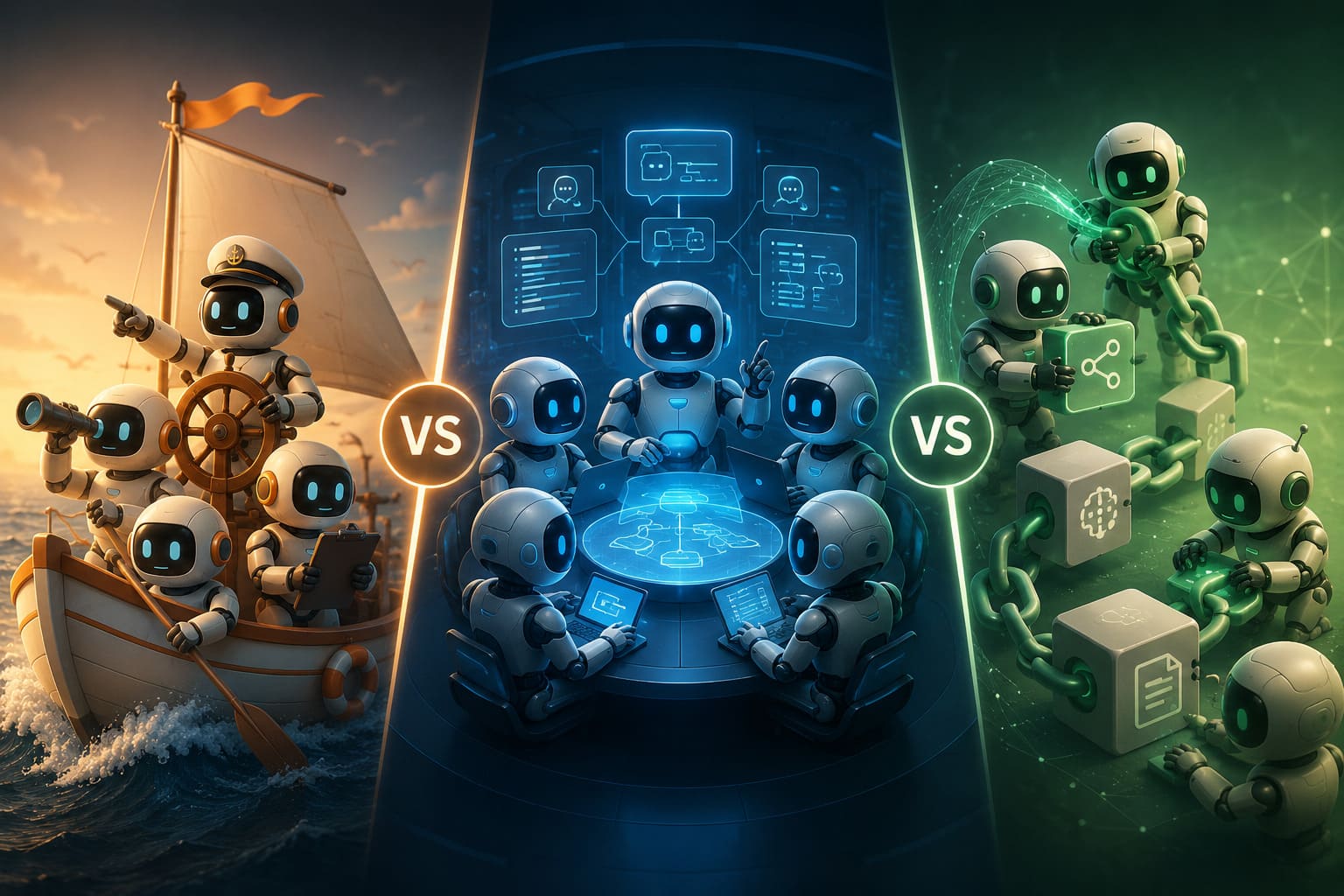
The Paradigm Shift: From Prompt Engineering to Agentic Workflows
In the rapidly evolving landscape of Artificial Intelligence, we are witnessing a fundamental shift. We are moving away from simple single-prompt interactions with Large Language Models (LLMs) and toward autonomous, multi-agent workflows. Instead of relying on a human to repeatedly prompt, copy-paste, and edit outputs, we are building systems where specialized AI agents collaborate, leverage external tools, and self-correct to complete complex, multi-step objectives.
However, building these systems from scratch is incredibly difficult. Developers must manage state, orchestrate execution loops, handle model failures, and design scalable interaction protocols. To solve this, three dominant frameworks have emerged as industry standards: CrewAI, Microsoft AutoGen, and LangChain (specifically its advanced agent orchestration extension, LangGraph). Choosing the wrong framework early in your development lifecycle can lead to architectural bottlenecks, unmaintainable codebases, and poor system reliability. This comprehensive guide provides an in-depth, technical comparison of these three giants to help you make an informed decision.
1. CrewAI: Pragmatic, Role-Based Multi-Agent Orchestration
Core Philosophy
CrewAI is designed around a highly intuitive metaphor: a human crew operating within a corporate structure. In CrewAI, you define specific “Roles” (e.g., Senior Research Analyst, Technical Writer, QA Specialist), assign them specific “Tasks” (with concrete inputs and expected outputs), and equip them with specific “Tools” (such as search engines, database connectors, or custom APIs).
CrewAI excels by abstracting the complex underlying mechanics of agent-to-agent communication into a clean, declarative Python interface. It is built on top of LangChain, acting as a high-level orchestrator.
Key Features & Strengths
- Structured Collaboration: CrewAI supports sequential, hierarchical, and consensual processes. In a sequential process, the output of Agent A becomes the input of Agent B automatically.
- Inherent Human-in-the-Loop (HITL): Developers can flag specific tasks to require human review before proceeding to the next agent, ensuring safety and quality control.
- Memory Management: CrewAI features built-in support for short-term memory, long-term memory, and shared contextual memory, allowing agents to retain context across task execution cycles.
Ideal Use Cases
CrewAI is highly optimized for structured, process-oriented workflows. It is perfect for content creation pipelines, automated financial reporting, market research analysis, and software development tasks that follow a logical, step-by-step lifecycle.
2. Microsoft AutoGen: Conversational, Event-Driven Agentic Systems
Core Philosophy
Developed by Microsoft Research, AutoGen is built on a very different premise: agents are conversational partners. In AutoGen, complex multi-agent cooperation is achieved by having agents send text-based messages back and forth. Its architecture is fundamentally event-driven and dynamic.
Key Features & Strengths
- Dynamic Conversations: Unlike CrewAI’s structured pathways, AutoGen allows agents to organically decide who speaks next based on the ongoing conversation, enabling highly creative problem-solving.
- Advanced Code Execution: AutoGen agents have a native ability to write, execute, and debug code dynamically in secure Docker environments. If a generated Python script fails, the agent reads the console error and self-corrects the code in real-time.
- Highly Customizable: AutoGen offers unparalleled flexibility in agent types, supporting LLM-based agents, human-proxy agents (which let humans intervene directly in the chat stream), and specialized tool-executor agents.
Ideal Use Cases
AutoGen is the go-to framework for open-ended problem solving, complex software engineering simulations, automated code generation and debugging, and scenarios requiring highly interactive, non-linear multi-agent debates.
3. LangChain and LangGraph: Low-Level State Machines and Custom Graphs
Core Philosophy
While LangChain initially began as a library of wrappers and utilities for LLMs, it quickly became apparent that traditional linear chains were too rigid for complex agentic behavior. To address this, LangChain introduced LangGraph. LangGraph models agent workflows as stateful, multi-actor graphs where agents are represented as nodes, and transitions are represented as edges.
Key Features & Strengths
- Stateful Graph Architecture: Every step of the graph writes to a centralized, version-controlled state. This makes it incredibly easy to implement complex loops, branching logic, and “time-travel” debugging (reverting state to a previous node).
- Granular Control: Unlike CrewAI and AutoGen, which hide the low-level execution loop, LangGraph forces you to define exactly how data flows. This yields absolute predictability, which is critical for enterprise production deployments.
- Massive Ecosystem Integration: LangGraph seamlessly inherits LangChain’s massive library of hundreds of integrations with vector databases, LLM providers, monitoring tools (LangSmith), and data loaders.
Ideal Use Cases
LangGraph is designed for production-grade, highly customized enterprise applications. If you need absolute control over agent state transitions, strict compliance logic, deterministic execution pathways, and integration into existing deep enterprise stacks, LangGraph is the undisputed choice.
Deep-Dive Comparison: State Management, Orchestration, and Developer Experience
To choose the right tool, we must examine how they handle critical software architecture concerns under the hood.

1. State Management
In CrewAI, state is passed implicitly via task contexts and shared memories. It is simple but can feel opaque when trying to debug complex data transformations. AutoGen handles state as a conversational history log; the “state” is essentially the message thread. This is incredibly natural for LLMs but can become bloated, leading to context window exhaustion. LangGraph handles state explicitly using a centralized state schema. It uses a database-like checkpointing system that allows you to pause execution, inspect state, and resume, making it by far the most robust for mission-critical apps.
2. Orchestration & Complexity
The learning curve directly correlates with the level of control you receive. CrewAI is the easiest to learn, allowing you to build a multi-agent system in under 50 lines of clean Python. AutoGen introduces moderate complexity, requiring an understanding of conversational loops and environment configurations. LangGraph has a steep learning curve, requiring concepts of graph theory, reducer functions, and explicit state schemas, but pays off in enterprise predictability.
Architectural Decision Matrix
When selecting your framework, consider the following trade-offs:
- Choose CrewAI if: You have a clearly mapped business workflow, your team wants to move fast, and you prefer a declarative, role-based setup where tasks are executed in a mostly linear or hierarchical path.
- Choose AutoGen if: Your primary agentic mechanism relies on conversational simulation, code writing and execution in sandboxes, or complex, unstructured collaborations where agents must dynamically negotiate solutions.
- Choose LangGraph (LangChain) if: You are building for a production environment that requires strict deterministic paths, complex cyclic loops, robust state rollback capabilities, and integration with LangSmith for enterprise-grade tracing and evaluation.
Conclusion
The era of single-prompt AI is behind us. Whether you choose the elegant, role-based coordination of CrewAI, the dynamic, code-executing conversations of AutoGen, or the precise, state-machine control of LangGraph, you are building the future of software. Assess your team’s development velocity requirements, the necessity of production-level observability, and the complexity of your workflow to choose the framework that will power your next-generation AI agents.